A person from Persia
Seven or eight years ago—which feels like it was eons ago because of the pandemic, the layoff, and the death of my parents—we met a young man whose parents are immigrants from Iran. I asked him if his name Sam was to make his life easier in America. After all, it is not uncommon for immigrants to adopt names that would make them less strange, perhaps even less threatening, to mainstream Americans.
His was not one of those. In Persian, it would be Saam, he said, a famous name in Persian mythology.
Curious that I always am, I asked him about the mythology. It was from the Shanameh, Sam said.
As if by mere reflex, I told him that I remembered reading about it in our history class in school, and about Firdausi. I had forgotten all about it until it came out of my mouth. When something like that happens, I always wonder what else is buried deep down in my memory and what might be the triggers for them to be revealed.
Sam, er, Saam, was in for an additional surprise. I told him that Bollywood had also made a movie about two characters from the Shanameh: Rustom and Sohrab.
A long time ago, I read somewhere that even as Arabic gained currency in West Asia as the language of science and math, Persian reigned supreme as the language of culture. Something like the comparison between French and German, I suppose.
It was a good thing that the Central Asians invading India brought along with them the Persian culture, which then filtered all the way down to memorable Bollywood stars who played memorable characters with memorable melodies.
Pankaj Mishra opens his essay in the NYRB recalling such a history:
Jawaharlal Nehru wrote in The Discovery of India that “among the many people and races who have come in contact with Indians and influenced India’s life and culture, the oldest and most persistent have been the Iranians.” It is the kind of historical fact readily verified by ordinary experience. My grandfather was more fluent in Persian than in any other language; I grew up using Persian words in everyday conversations, eating food that originated in Persia, and listening to music whose most widespread and enduring forms—qawwali and the ghazal—were refined by a medieval poet in Persian.
For nearly a millennium, Persian was the lingua franca of Asia: the language widely used by political and intellectual mandarins and necessary, too, for travelers such as Marco Polo and Ibn Battuta, who both deployed the language in China. Indeed, if Persian nationalism has maintained a profound sense of historical continuity transcending many different political regimes, it is because of its roots in the achievements of an expansive and long-lasting Persian civilization, or ecumene. Translated into many vernacular languages, the poetry and philosophy of Firdausi, Attar, Rumi, Hafez, Sa‘di, Nizami, Ibn Sina, and Nizam al-Mulk assumed a canonical authority across Asia. Rulers everywhere, whether Muslim, Hindu, or Buddhist, adopted Persian ideologies of statecraft that, as Richard Eaton writes in India in the Persianate Age: 1000–1765 (2019), privileged “the notion of justice and connecting economy, morality and politics.”
The far better writer that Mishra is, he clearly articulates what I would struggle to convey over multiple pages:
Living in India, I felt no esteem for either the venal Shah of Iran or Iran’s revolutionary regime, which, intolerant of political dissent and women’s rights from the start, became more tyrannical during Iran’s ferocious long war with Saddam Hussein, then the West’s proxy.
At the same time, my intimate awareness of the many challenges, setbacks, and disasters of postcolonial nation building during the cold war precluded the reflexive Western attitude toward Iran of fear and loathing underpinned by near-total ignorance.
Mishra is only a couple of years younger than me, and we were kids when the Shah of Iran was driven out of the country in 1979, which was a fateful year as I wrote in one of my columns for the Register-Guard. I wrote in that commentary:
If ever there was a competition for which year since World War II will qualify for the title of Annus Horribilis, 1979 could be a leading candidate. First, a list of some of the events from that year
Jan. 16: The shah of Iran flees the country, and goes into exile.
Feb. 1: Ayatollah Ruhollah Khomeini returns to Iran, and is warmly welcomed by millions of Iranians.
April 4: Former Prime Minister Zulfiqar Ali Bhutto is hanged in Pakistan.
July 3: President Jimmy Carter signs a directive to support the opponents of the pro-Soviet government of Afghanistan.
July 16: Saddam Hussein becomes the president of Iraq.
Nov. 4: Americans in the U.S. embassy in Tehran are taken hostage.
Nov. 20: Armed dissidents stunned the ruling Saudi family by seizing the Grand Mosque in Mecca
Dec. 25: The Soviet Union begins to deploy troops in Afghanistan.
Look at that list again. Think about the global ramifications of those events that we are dealing with even today.
The old stories, all that history, do not matter to the authoritarian and his toadies who are not interested in promoting peace and harmony. We are where we are today because the authoritarian’s act in his first term when he threw out the nuclear deal that was “signed in 2015 by the United States and Iran as well as China, Russia, France, Germany and the United Kingdom.” What could have been a path to peaceful coexistence with a theocracy that we disagreed with has instead been turned into a global war in 2026.
Mishra writes in his concluding paragraph:
Marco Rubio’s encomiums to white Western civilization, and Hegseth’s pornographic fantasies of “death and destruction from the sky all day long,” proclaim today a sadistic urge to re-impose the racial hierarchies of the nineteenth century.
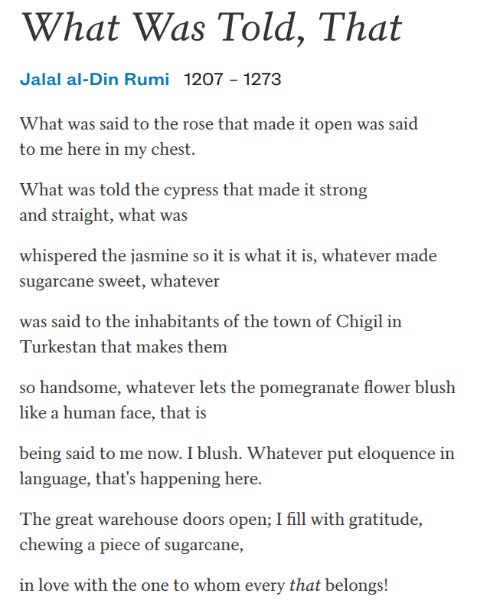
Perhaps the best way to wrap up this post is with a poem from another Persian from centuries ago: Rumi.