
All about me
And about Maugham too
Reading “The House of Doors” has been an interesting challenge for one reason: I often pull up Google in order to search for a place name or a person’s name that the author Tan Twan Eng casually mentions while telling the story, which he does really well.
Here’s an example. The story is set in Penang in what was a century ago the British Malaya. One of the principal characters in the story, a British woman, remarks about “tiffin carriers”. Tiffin carrier? In Malaysia a hundred years ago?
Allow me to explain why I was puzzled. The tiffin carrier is not new to me. We grew up with tiffin boxes and tiffin carriers at home. When we were young, we put those tiffin carriers to a lot of use—having lunch delivered to us by the maid, food while traveling by train, and even to get meals from the nearby restaurant. There were no “to-go” disposable containers until recently, which required us customers to take tiffin carriers to restaurants, and the different dishes and rice would be packed in the tiers of the carrier. The ones that we used are now in the storage loft in my sister’s kitchen. Maybe I should consider bringing the smaller one to America.
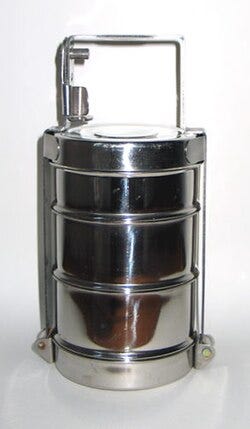
Non-Indians who have watched the movie “The Lunchbox” would also be familiar with tiffin carriers, which are delivered on schedule with some remarkable logistics by dabbawalas.
But, I hadn’t imagined that the tiffin carrier would have diffused through the British Empire, which is why I googled to learn more about this cultural diffusion.
Wikipedia informed me that the tiffin carrier spread to Malaysia and Singapore, and even to Trinidad and Tobago!
“The House of Doors” is a fictionalized imagination of W. Somerset Maugham’s travels. I grew up as a fan of Maugham’s storytelling and, naturally, I am hooked.
There were two reasons that I got into Maugham, one was at school and the other was at home.
One of the stories that we read in school was Maugham’s “The ant and the grasshopper” in which he retold the old Aesop fable through the lives of two brothers but with an ending that also reversed the moral that the original fable delivered. The way Maugham portrayed the characters, the settings, and the manner in which he delivered the punchline, so to speak, was addictive that I wanted to read more by Maugham.
At home, appa was a big fan of Maugham’s. From his narrations, it was evident that appa had done a lot of reading until he got married and got bogged down with the everyday life as an engineer, a husband, a father, and a dutiful son to his mother. Of Maugham’s short stories, appa’s favorite was “Mr. Know-All”. Two of the few books that appa owned were by Maugham: “Of Human Bondage” and “The Summing Up”, which I read way early in my life; I would have understood them a lot more had I read them after some meaningful exposure to the world.
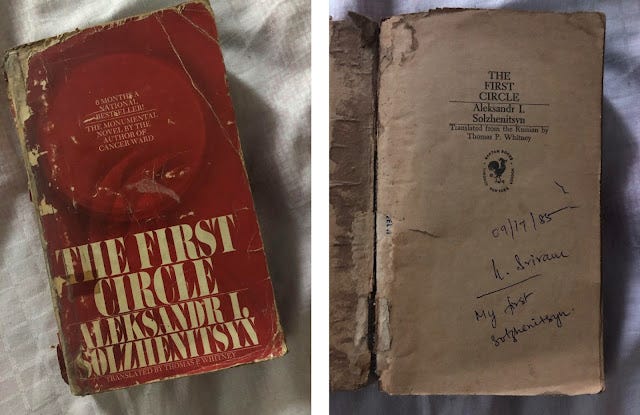
Seven years ago, I helped appa and amma get ready to move in with my sister. Except for a few religious books that they wanted to take with them, we donated most of the rest to the local vendor who bought used paper. That’s all they were at that time—used paper. Dust to dust and ashes to ashes for us humans, and paper to paper for books, even Maugham’s. Not that it was easy to do. I had a tough time convincing my parents that there was no option other than to get rid of those possessions, including a few books of mine that I had left behind with them, like this one:
There was that one time when appa praised my writing, even if it was merely from a parental duty to exaggerate a child’s accomplishments. Not that I was a kid when he offered that wonderful feedback; I was well into becoming a balding middle-aged man.
Every few months, I put together a collection of blog-posts (from the old blogging platform) as a themed booklet for him and amma to read. The high praise was when appa remarked that some of my narrations of travel and the people that I ran into reminded him of Somerset Maugham's storytelling, of the characters he portrayed and the places he described.
After reading those collections, appa did not toss them away. He saved them. He also numbered them in the chronological order in which I had put them together and sent them. After appa died, I decided to bring those booklets with me. When scanning through them, I noticed that he had even marked, underlined sentences and paragraphs that, I suppose, caught his attention, or made him think. An even higher praise than anything that I could have imagined!
Well into my life in the US, I began to understand other aspects of Maugham’s. Like the remarkable number of stories and novels that had been adapted for television and movies. And about his sexuality. I have no idea whether appa knew about Maugham’s personal life. Perhaps it did not matter to appa even if he knew. But then, does it matter at all if a master storyteller is straight or gay or bisexual?