
Am I a hippie?
Asha Bhosle died a few days ago, on the 12th. She was 92 years old.
People from the Subcontinent, old or young, know that name really well, and the older the person is, the more familiar we might be with her songs. A quick briefing from the Guardian for those who might be unfamiliar with the Subcontinent: Bhosle was an “extraordinary artist whose career spanned over eight decades, during which she recorded about 12,000 songs.”
She first became famous as a playback singer – recording songs that would then be lip-synced by actors in Bollywood movies. Though she was not on screen, her voice made her even more celebrated than those pretending to sing her songs. She also recorded extensively under her own name.
My earliest memory of one of Bhosle’s songs is from a movie that might seem to be all about India and the Hindu faith but is far from that. The movie’s title: Hare Rama Hare Krishna.
I was a kid, a curious kid, when the song was famous even in the anti-Hindi Tamil Nadu. I had no idea what “dum maro dum” meant but those words and “Hare Rama Hare Krishna” were the only words in the lyrics that I knew, and that worked well to sing along.
Later, I understood that the movie, which I have not watched in all these years, is a take against westernization, which was a common motif in Indian movies all through my life in the old country. And, yes, “Hare Rama Hare Krishna” refers to hippies from the US and European countries mouthing those phrases, and some even belonging to the International Society for Krishna Consciousness (ISKCON) movement.
Into my teens, whenever I delayed going for a haircut, with my curly hair puffing up—ah, those were the wonderful years when I had lots of hair!—my father would bug me to get my hair cut and sometimes make references to the unkempt and long hair as being hippie-like.
It was during my engineering college years that I finally understood that “dum maro dum” is about taking a hit, about drugs, which is also associated with hippie culture.
In my adult life, nobody ever thought “now, here comes a hippie” when they saw me walk into a room, or anywhere.
For one, the stereotype makes one think of a white person and not those who are brown-skinned. Beyond that, I have always been a regular guy who does not have long hair, and does not smoke or drink or do drugs. There is no visual clue for anyone to think, “here’s a hippie”.
But then, who is a hippie?
In the counterculture years of the 1960s and 1970s, going against the conventional norms meant different things for different people. When African-Americans challenged the system, it was considered to be a political movement, though there were plenty of cultural currents—sometimes hidden, like how Martha and the Vandellas’ “Dancing in the Street” became an anthem for civil rights protests and urban riots too. The farm workers movement, women’s rights, … plenty of examples of people individually and collectively challenging the system, the establishment.
Unlike African-Americans, unlike the Filipino and Mexican farm workers, White middle class males (mostly, and a few females too) had the luxury of dropping out of the system as a way of being counterculture. The much poorer African-Americans, for instance, simply could not afford to drop out when they were engaged in a fight to be included as equals.
Add to dropping out a layer of romanticizing the old cultures and traditions and, well, in no time hippies were in places like Nepal or Goa in India, which is also the setting for the movie “Hare Rama Hare Krishna”. Or the White people I saw at Kovalam beach, which is not far from Trivandrum (Thiruvananthapuram now) that we loved going to during the summer holidays. The image of White people who had dropped out to be in Goa against a background of poor, Brown masses is quite a jarring juxtaposition of contrasts.
In 2026, here’s how Merriam-Webster defines the word:
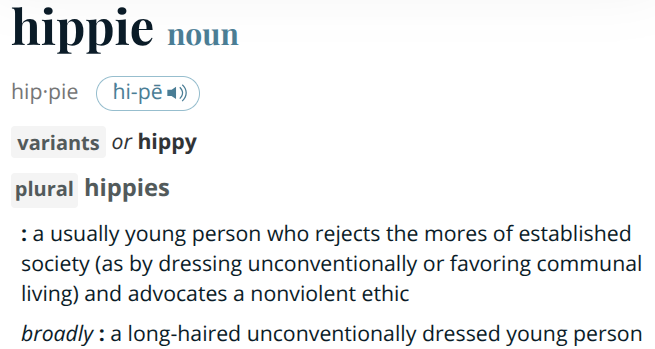
If I look past the superficial, appearance, of a long-haired male or dressing unconventionally, then could I call myself a hippie, even though a teetotaler-hippie might be one hell of an oxymoron? I advocate for a nonviolent ethic all the time, don’t I? I might have to kill you if you disagree with me on this. 😁
If the defining characteristic of a hippie is to question or reject “the mores of established society”, well, hey, I have been doing that my entire adult life in the old country and here in the adopted country too! I am a hippie who rejects the mores of hippiedom as well. 😁
The word that I prefer is “irreverent”. I would think that when in pursuit of truth, which often means questioning the accepted norms, we naturally become irreverent. In this pursuit, sorting through the hype and the bullshit, some of us become irreverent to the core. This life of irreverence is, I believe, richer and more exciting than the one in which one unquestioningly, religiously, accepts the prevailing norms.
There are a number of songs sung by Asha Bhosle that I pull up every once in a while, thanks to YouTube, even though I have watched very few Hindi movies in my life. One of my other favorites of hers is from Umrao Jaan, which is also a movie that I have not watched. My, what a song and visuals to go with that (even in the low quality video below)!