
Madam, am Adam
Back in July 2012, when reading an essay, I came across a reference to the National Geographic’s Genographic Project.
National Geographic’s analysis of your Genographic Genetic Information will produce your deep ancestry insights. Deep ancestry is your ancestry from hundreds or even thousands of years ago. It’s based on the paths your ancient ancestors took to migrate around the world. As noted above, we’re calling these results your Genographic Genetic Information.
I decided to participate in that as a gift to myself. This was not the typical ancestry project where people might try to trace back their lineage. I was less interested in that, given how much I know about my people going back a few generations. My interest was in the big picture: How did I get to India from East Africa?
I asked only for the male side of history; after all, only males can get the male side of the story—the Y chromosome. The reasoning is this:
The Y chromosome is passed from father to son remaining mostly unaltered across generations, except for small traceable changes in DNA. By tracking these changes, we constructed a family tree of humankind where all male lineages trace back to a single common ancestor who lived hundreds of thousands of years ago. This human tree allows us to explore lineages through time and place and to uncover the modern history of your direct paternal surname line and the ancient history of our shared ancestors.
(National Geographic ended this genetic information project a couple of years later.)
In July or August 2012, I got the results of the Y-chromosome DNA analysis, which told quite a story of my origins from Africa.
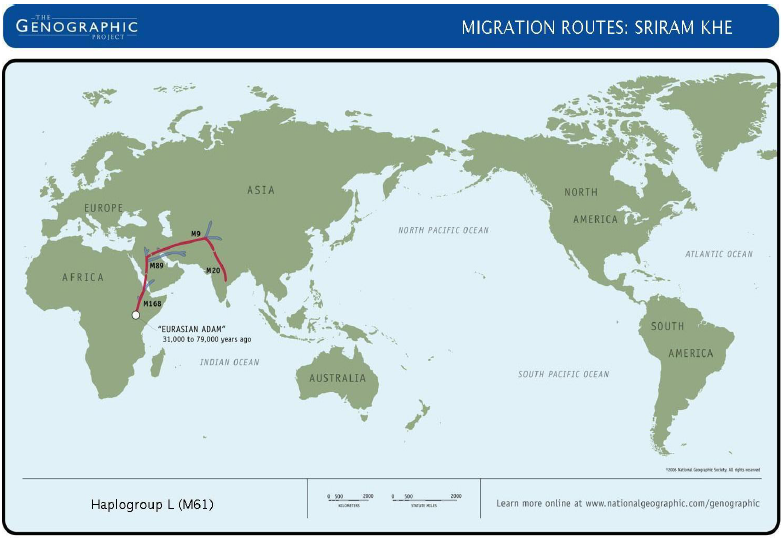
The genetic map shows how I got to India, all the way from Africa:
The report noted:
The man who gave rise to the first genetic marker in your lineage probably lived in northeast Africa in the region of the Rift Valley, perhaps in present-day Ethiopia, Kenya, or Tanzania, some 31,000 to 79,000 years ago. Scientists put the most likely date for when he lived at around 50,000 years ago. His descendants became the only lineage to survive outside of Africa, making him the common ancestor of every non-African man living today.
That “Adam” is the common ancestor of every non-African man living today. How about that!
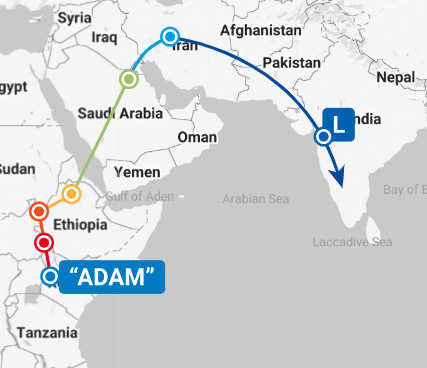
About the migration itself:
Your ancestors, having migrated north out of Africa into the Middle East, then traveled both east and west along this Central Asian superhighway. A smaller group continued moving north from the Middle East to Anatolia and the Balkans, trading familiar grasslands for forests and high country.
And then from there,
Your next ancestor, a man born around 40,000 years ago in Iran or southern Central Asia, gave rise to a genetic marker known as M9, which marked a new lineage diverging from the M89 Middle Eastern Clan. His descendants, of which you are one, spent the next 30,000 years populating much of the planet.
A man born around 40,000 years ago somewhere in the neighborhood of Iran was Adam #2, whose descendants pretty much populated “much of the planet”.
Ah, my people!
Getting close to India ...
The man who gave rise to marker M20 was born in India or the Middle East. Your ancestors arrived in India around 30,000 years ago and represent the earliest significant settlement of India. For this reason, haplogroup L (M61) is known as the Indian Clan.
So, there! Everything else was easy, it seems like. (The science behind all these is head-spinning.)
But, wait, the people who arrived about 30,000 years ago were not the original settlers in the Subcontinent. Nope.
Although more than 50 percent of southern Indians carry marker M20 and are members of haplogroup L (M61), your ancestors were not the first people to reach India; descendants of an early wave of migration out of Africa that took place some 50,000 to 60,000 years ago had already settled in small groups along the southern coastline of the sub-continent.
By the time my genetic ancestors arrived in India, they were immigrants in a land that was already populated, and this was about 30,000 years ago! Mind. Blown!
I opted to share my information within the project, thanks to which every once in a while I get emails informing me about exact matches with a Y chromosome marker. I got one such email earlier this morning.
Here’s a sample map that the project website automatically generated with some of the exact matches—most of them with Muslim names—geocoded as red-pins:
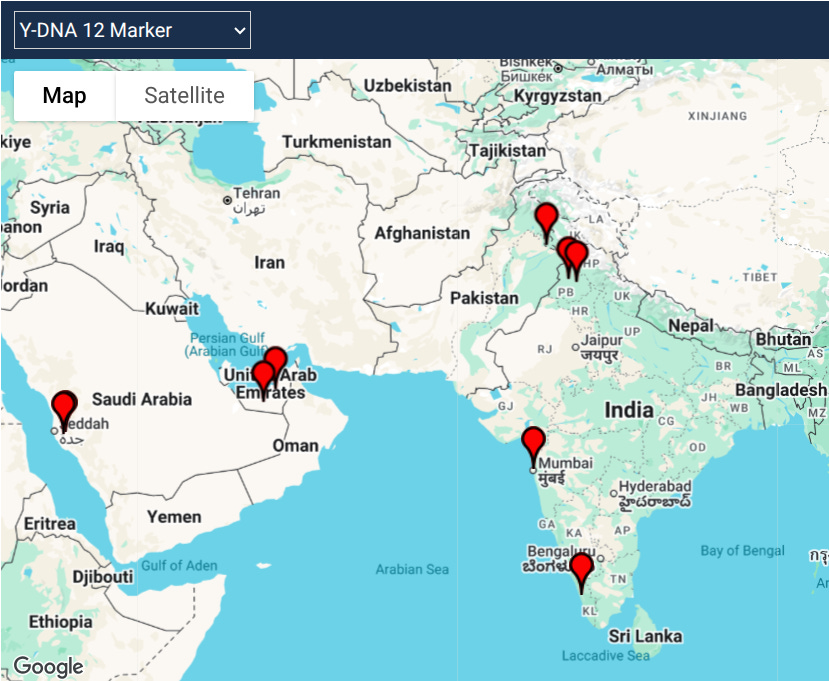
Of course, the people in the project have self-selected to participate. Nonetheless, it adds real evidence, as in real people, to the migratory map.
When we take such a long view of where we come from, we will lead humbled lives. We won’t care to think about whether we are different from others, and whether there are some who are inferior or superior to us. We will recognize our shared past and work together as one.
But, we are humans and we resist recognizing our shared past. So, we go about the world think we are better than “others”. We even think, believe, that “others” need to be wiped out from the planet. We homo sapiens are a weird, strange, species that came out of Africa!
PS: The title of this post is a palindrome. Some of us love(d) such word play, and this was the first one in the English language that I came across as a kid.