
Outsiderdom
Have I ever told you what a fantastic public library we have in town? Of course I remind you about that, over and over again, right? 😁
Here’s the latest reason. I searched the library’s collections for “The Other Americans” by Laila Lalami. The library did have a copy, and it was available. Our small town library has one amazing collection!
I am halfway into the novel and, yes, it is certainly of the quality that a reader would expect from a National Book Award finalist.
I am fairly confident that I have never come across this author nor her works until I read about her latest book in the NYRB. I barely read the first four paragraphs in that review essay when I decided that I would rather read one of Lalami’s novels first before I read that review. The reviewer noted:
From the start of her career, Lalami has been a nuanced and discerning chronicler of the immigrant experience and of those who exist at the margins of society. Her nonfiction book Conditional Citizens is a personal exploration of what it means to be an American. Her novel The Other Americans was a finalist for the 2019 National Book Award in fiction.
Those sentences, in addition to the three paragraphs that preceded them, were enough for me to search for Lalami’s works in the public library’s collections.
Lalami was born in Morocco and, like many of us, came to the US for graduate schooling. It turns out that she and I earned our PhDs from the same university—USC, in Los Angeles!
The USC-fiction nexus is growing for me. First, it was Percival Everett, who has been teaching at USC for quite some time. (I thoroughly enjoyed his “James”, “So Much Blue” and the movie “American Fiction” which is based on his “Erasure”. I am pretty darn sure I read one more of his, but can’t recall the title.
Then there is Viet Thanh Nguyen, who also teaches at USC. Jonathan Escoffrey. And now Laila Lalami, who is a USC product. Go Trojans!
Laila Lalami writes in her website:
I never expected to become an immigrant or to be writing fiction in English, but these two decisions have had a profound impact on my creative and critical thinking. My fiction frequently deals with themes of home, and my characters tend to be outsiders, people who don’t quite fit in anywhere.
Of course, in the novel, Lalami’s characters are not all immigrants. But, the “native” characters are also outsiders who can’t quite fit in well with society. It has been a fantastic read so far, and there is no reason to suspect that the rest of the book will be less interesting.
We immigrants can immediately identify with being outsiders who don’t quite fit anywhere. Not because we want to be outsiders, and not because we don’t know how to assimilate and fit, but because it pretty much goes with the territory of being an immigrant. How much ever Americana that I am fluent with, perhaps even more than the typical American is, I know I will be considered an outsider here in the US. A foreigner who became an American but is still considered a foreigner.
When visiting India, this "Indian" is again a foreigner, on the streets, in the stores, and even to my family. A few years ago, during one of my visits, my father told me that I didn't know how things are done in India and that I was talking like an American. My father was correct.
But being an outsider is also advantageous, which is how Pico Iyer views it:
It’s a blessing to be a foreigner everywhere, detached and able to see the fun in things.
His last name Iyer is familiar to us from my part of the old world. Wikipedia gives details:
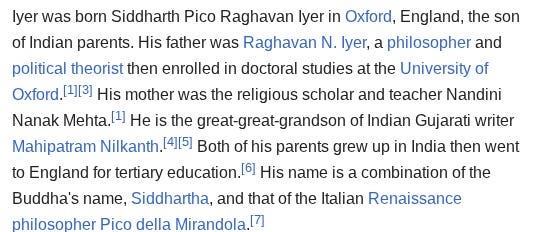
And: “Iyer has been based since 1992 in Nara, Japan,[26] where he lives with his Japanese wife, Hiroko Takeuchi.”
An ultimate outsider everywhere, Iyer wrote:
As some are born with the blessing of beauty or a musical gift, as some can run very fast without seeming to try, so I was given from birth, I felt, the benefit of being on intimate terms with outsiderdom.
In this essay that Lalami links to in her website, she reflects on her growing up experiences in Morocco, about her book-reading working class parents who didn’t go to college, and about the kinds of books that she and friends read when they were young. She writes:
Of course, none of the characters in these books looked or spoke like anyone I knew. In those days, in the late 1970s, nearly all of the children’s literature that was available in Moroccan bookstores was still in French. The characters’ names, their homes, their cities, their lives were wholly different from my own, and yet, because of my constant exposure to them, they had grown utterly familiar. These images invaded my imaginary world to such an extent that I never thought they came from an alien place. Over time, the fantasy in the books came to define normalcy, while my own reality somehow seemed foreign. Like my country, my imagination had been colonized.
What a simple and powerful sentence it is that ends the paragraph: “Like my country, my imagination had been colonized.” We may have earned doctorates from the same university, but not all graduates are created equal!
I have blogged often about how colonization was not merely some aliens from an island in the northern latitudes ruling over us, it resulted in being severed from our own identities and histories and even languages.
“No man ever went to the East Indies with good intentions,” wrote Horace Walpole, and than can be extended to any European colonizer in any part of the world. The melanin-deficient Europeans roamed the far corners of the earth, imposed their customs, religion, language, and themselves too, on brown people everywhere, which is why I ended up thinking and writing in English, instead of carrying on with one of the oldest languages ever.
I am often reminded of this:
‘It is hard to realize,’ Coomaraswamy writes in The Dance of Shiva, ‘how completely the continuity of Indian life has been severed. A single generation of English education suffices to break the threads of tradition and to create a nondescript and superficial being deprived of all roots—a sort of intellectual pariah who does not belong to the East or the West.’
Or, as Lalami puts it, our imaginations had been colonized. What a wonderful way to describe our awful condition!
Lalami continues:
Two years later, I arrived in Los Angeles, to do a PhD in linguistics. I spent most of my days working on research articles and conference papers that had to be written and delivered in English, which made me think even more about the relationship between Arabic and French in Morocco. French was not just a prominent language in Morocco. It was the language of power; an indicator of social class; a means to include or exclude people. The education I had received had emphasized the importance of French to the detriment of Arabic. French was used in our media, our government, and our businesses. Nearly half of the shows on Moroccan television were bought from and dubbed in France. There were no neighborhood public libraries, so we often had to depend on cultural centers, like the one sponsored by the French government, for free access to books. The role of French in my life became clearer. Writing in French came at a cost; it inevitably brought with it a colonial baggage that I no longer wanted to carry.
Billions of us carry that heavy colonial baggage, which we cannot really get rid of, can we?