
Suck it up?!
A couple of weeks prior to the fateful election in November 2024, The Economist published a special report with a header that said it all:
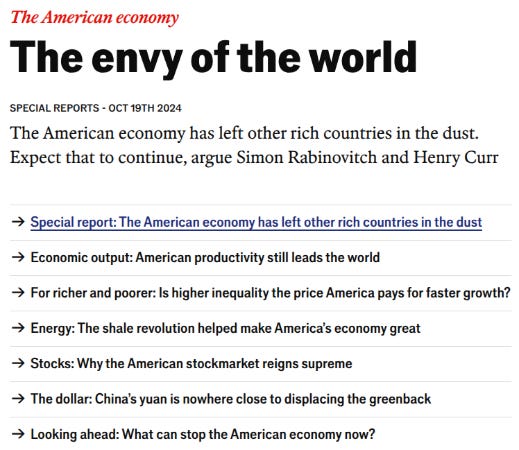
The envy of the world. Such was the state of the American economy that Biden presided over, which his successor would inherit.
And then the authoritarian won the election.
Everything that we feared about the authoritarian, everything that Kamala Harris warned about, has come true. Harris tried to convince voters that her opponent is an unserious man whose actions would have serious consequences. But then she is a woman. A Black woman. An Indian-American. So, of course, more than half the country decided that she was not fit to be President. Instead, they chose a man with a long track record of abusing people, a man who had been impeached twice in his first try at the presidency, the second impeachment coming after he rallied his base to attempt a coup at the US Capitol where the 2020 election results were being certified.
It has now been 81 days since the authoritarian teamed up with his equivalent in Israel and launched kinetic activity a war against Iran, even though there was no imminent threat to the US.
As a result, gas prices have shot up, and continue to climb. Global supply chains have been affected causing additional price increases.
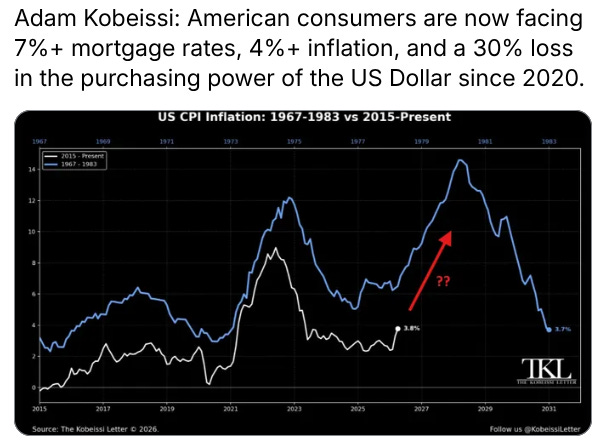
The authoritarian does not care:
Trump was asked whether the economic hardship Americans are feeling would motivate him to make a deal to end the war.
“Not even a little bit,” he said.
“I don’t think about Americans’ financial situation,” Mr. Trump continued, a stunningly frank admission that came after weeks spent either downplaying the conflict’s economic toll or simply asking Americans to be patient.
He does care about his billion dollar ballroom.
“I don’t really have enough time to explain it to people,” Mr. Trump said about the complexities of the war and the dangers of Iran having a nuclear weapon. He said he was “too busy getting it done.” But on Tuesday, he had ample time to go over his design choices for the ballroom.
“If you take a look at this section,” Mr. Trump said, pointing to the different styles in the ballroom’s design and describing how they were inspired by ancient Greek or Roman architecture. “This is a Greek, more or less. It comes out of Greece. This is the ultimate facade for Greece. This face is the Treasury building. This face is a different facade — that’s Rome.”
The war has also messed up the authoritarian’s good fortunes in the old country.
All of a sudden, conditions have worsened in India. The wonderful combination of factors that boosted India are rapidly evaporating and the authoritarian there is facing a new combination of factors that flash red lights all around.
After he won the first time in 2014, the Indian authoritarian inherited the economic policies that had been put into place by his technocratic predecessor, Manmohan Singh. He began coasting on two decades of economic growth. This editorial in the Guardian makes a good point:
Mr Modi treated globalisation as durable enough to justify India’s deeper, more confident integration into world markets. China’s rise also altered Indian ambitions. The underlying assumption among elites was that India was too big to fail. That idea bred complacency.
Pride before a fall, they say.
The Kolkata-based newspaper, The Telegraph, sums it up in a headline:
Indian economy faces perfect storm with oil above $100, rupee in freefall, inflation back
Add to that the forecast of below-average precipitation during the June-September monsoon season, and life for the hundreds of millions of low-income Indians will become challenging in a matter of months.
Mitali Mukherjee, who is the Director of the Journalist Programmes at the Reuters Institute for the Study of Journalism, University of Oxford, writes in The Hindu’s Frontline magazine:
The bitter truth is this. The dam has broken; the rupee is reflecting it, the outflows from India are confirming it and none of the most critical fault lines in India have been mended in the last decade and some. …
India’s leader can wring his hands and make promises that sound ambiguous enough to come across as earnest attempts. But wading out of this crisis is not the responsibility of Indian citizens. It’s the responsibility and duty of an elected government that took charge twelve years ago and allowed things to come to break point.
Authoritarians care only about themselves and their power, which is what we see in my old country and adopted country.
There was an interesting intersection of the personal politics of both these authoritarians.

Who is Adani?
Mr. Adani, 63, is a titan of industry in India whose fortune has grown explosively with India’s rise as a global economic power under Prime Minister Narendra Modi, a close ally. He has a net worth of more than $100 billion, according to Bloomberg’s Billionaire Index. The share price of his flagship conglomerate company, the Adani Group, has risen sharply during Mr. Modi’s 11 years in power.
Thanks to our authoritarian, the friend of India’s authoritarian goes free.
Pain is exclusively only for us lesser mortals.