The end game
In this NYT opinion essay, Sandep Jauhar, who is a cardiologist in New York and who regularly contributes to the opinion pages, writes about his father whose Alzheimer’s was near the end-stage when “he could barely get out of bed or dress or feed himself.”
Jauhar writes: “We soon encountered a harsh reality, however. Dying at home isn’t easy, even with hospice care.”
The hospice system, we learned, requires family involvement in the dying process to a degree that even we, as a family of doctors, weren’t comfortable with. We were responsible for bathing my father and helping him use the toilet, changing his clothes and, most daunting, administering morphine and other sedatives to treat his pain and anxiety. A nurse was scheduled to come to the house only for about an hour twice a week. Getting an aide to help with basic activities of daily living was nearly impossible.
Even before I read the rest of the essay, my mind drifted away thinking about the months that my mother was in hospice care, and the very short time, a couple of weeks, that my father was in hospice.
I shuttled between Eugene and Chennai, leaving for India every few months and sometimes spending two months at a stretch there, while my sister took care of them on a daily basis. In Chennai, and unlike the New York scene that Jauhar describes, my sister could hire nursing assistants who were responsible for toileting, bathing, and changing clothes, the chores that can be physically and mentally exhausting to caregivers. When needed, the geriatricians who were taking care of my parents made home visits, evaluated them, and suggested the adjustments that would make appa and amma comfortable. What a wonderful contrast to the hospice care at New York that Jauhar describes!
Of course, such at-home hospice care in Chennai is expensive and, fortunately, my parents and we siblings had the necessary resources.
Jauhar writes:
When Cicely Saunders, a nurse and doctor, opened the first modern hospice program in London in 1967, she laid out three guiding principles for easing the process of dying: relief of physical pain, preservation of dignity and respect for the psychological and spiritual aspects of death.
While this is the first time I am learning about Saunders and her program, it is an immense relief and consolation that the hospice care that appa and amma received at home fully and completely satisfied all those three criteria.
The doctors who made home visits to check on appa and amma came from a hospital, which is where a few years ago my parents became patients. The hospital’s name says it all about what their specialty is: GeriCare.
The hospital is located close to my sister’s home, and my parents had moved in with her by then. What a convenience!
When appa was 90 years old, he developed a bladder infection for which he met with the specialists at that geriatric hospital. Before the doctors even began their diagnostic procedures, he told them that he did not want any surgical treatment, and ruled out any serious intervention. They assured and reassured appa that geriatric medicine takes all that into consideration. He did not believe them, until he returned home after spending five days in hospital. He came back a much healthier 90-year old. And then appa started singing the praises of GeriCare to everybody who cared to listen to him.
So much was appa impressed with their approach to treating the elderly, and the remarkable quality of hospice care they provided for amma, that he was emphatic that the hospital be thanked in the obituary notice in the newspaper after amma died, which is highly unusual in the old country. Respecting his wishes, we thanked the hospital’s team in appa’s obit too—almost six years after his first encounter with GeriCare.
Here in the US, even though we have had plenty of time to prepare for an aging population and their healthcare needs, well, we have not done a damn thing. If only voters had listened to Kamala Harris, whose proposals included expanding Medicare coverage “to help cover the costs of home health care aides for seniors.”
I am not sure whether people without a lived experience in India can truly understand the phenomenal changes in healthcare in the old country that have happened in a very short period of time. When I was a kid, the country needed tens of thousands of pediatricians (paediatricians, as spelled in the old country) and now there is a need for geriatricians.
Here in the US, healthcare seems to be regressing on all practical matters, including about geriatrics. This commentary is all about that very problem:
Ideally, health care in later life should go beyond just treating individual diseases and medical conditions. It should aim to help older people maintain health, independence and optimal quality of life for as long as possible.
Doctors and nurse practitioners trained in geriatrics specialize in doing exactly that. As a geriatrician for nearly four decades, I’ve seen how the right care for older people can prevent falls, reduce risk of medication side effects and help patients make medical decisions that reflect their goals and wishes.
The problem? There just aren’t enough of us.
We spend gazillions on bombing the shit out of people all across the world but cannot be bothered with a domestic problem that will quickly worsen.
Nationally, there are fewer than 12 geriatric physicians and 10 geriatric nurse practitioners per 100,000 older Americans. In many rural areas, there are none. And the shortage is unlikely to improve anytime soon. That’s because medical students and advanced practice nurses rarely choose to specialize in geriatrics, and many medical schools provide no formal training in the care of older adults.
This means most older adults will be cared for by clinicians without specialized geriatric training.
The essay suggests strategies for what one could do on their own. At the end of it all:
Aging well is not about having more doctor’s appointments or medical tests, nor is it about taking more medications. It’s about getting the kind of health care that will maintain function, independence and quality of life into old age. You may not be able to find a geriatrician, but you can definitely help your doctor better understand the care that’s right for you or your loved one.
As soon as I finished reading Sandeep Jauhar’s NYT opinion essay, I messaged appa’s cousin who is an intensive care specialist in New York, thanking her for the phenomenal medical and moral support that she voluntarily provided from afar and which we desperately needed throughout the hospice care months.
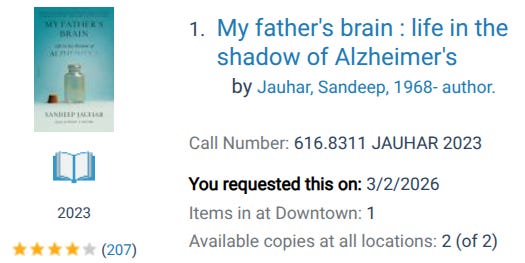
Then, I looked up the library catalog for Jauhar’s books. And placed a hold on one of them: