
Who are your waters?
I did not know anything about Robert Macfarlane, who was in town on Tuesday as the featured speaker in a series “designed to inspire conversation about the complex and interdependent relationship between humans and the natural world.”
I could have done a simple Google search for his name and, maybe, I would have then decided to attend the talk and listen to the Q/A. But, I did not.
Today, while running errands, which here in America means driving to a couple of places, I decided to listen to the radio, which I usually do not. I used to in the past, but after the authoritarian came to power, I worry about having to listen to his grating voice and tone should they play a clip of his ranting about something.
Anyway, I turned the radio on. Robert Macfarlane was the guest on the show, Think Out Loud. I suppose the cosmos wanted me to listen to his views on humans and the natural world. So, I did.
It was a rebroadcast of a show that originally aired a year ago. The title of this post is from the conversation between the show’s host, Dave Miller, and Macfarlane:
Miller: You write early on that in Māori, you can greet someone new by asking ko wai koe – I’m probably not pronouncing that correctly – which translates as “who are your waters?” Who are yours?
That’s an awesome question to ask someone we meet for the first time.
So, yeah, who are your waters?
Macfarlane replies:
Mine are many, but I’ll take two. One is this little spring that rises a mile from my home. I live on chalk. It’s fragile, it’s clear where it begins, it’s adulterated as it passes through the city only a mile further downstream. It’s my friend. I visit it often, spend time with it, think with it.
And the other is also a spring, but it’s a high altitude spring. It’s the source of the River Dee. My other heartland is the highlands of Scotland. This spring rises vigorously as bubbles in a kind of granite aquifer that soaks full on the summit of the Cairngorm plateau, which is the closest thing we’ve got to the Arctic. It gathers, then it crashes almost immediately down into Garve quarry, one of the deepest quarries in the Highlands. And then it flows away and becomes the Dee. Two sources.
What he said in the follow-up about those waters was even more interesting:
My father and brother went on a pilgrimage to the Cairngorm Spring the month this book was published. They gathered a flask of water for me. And some of that water is in the ink which is in the pen with which I signed these books. So the spring is with me right now, a tiny, tiny element of it.
That’s one tight connection right there, yes?
You can listen to the conversation or read the transcript. Macfarlane talks extensively about his time in Chennai and working with an activist/naturalist Yuvan Aves, who was an unknown to me until now, though I am familiar with another environmental activist, Nity, whom Aves mentions elsewhere in an interview as important influence.
McFarlane said in his conversation with Miller, about the flask of water from Cairngorm Spring and other talismans:
We store our memory and also our feelings in external objects. Like hard drives as it were, but hard drives don’t need to be made of silicon, chips and bits. They can be bracelets, they can be stones carried in the hands, they can be water carried in a bottle. And yeah, these mean a lot to me. They carry a certain magic, they conduct memory, they condense thought. Yeah, I think with them, absolutely.
In the old country, in the different ways that the Hindu religion is practiced, one can see many kinds of talismans. A turmeric-tinged thread on the wrist. Black thread on the wrist. Black thread with knots. Or around the neck. Rings. Bracelets. Or the sealed flask of water from the holy Ganga. And more.
Quite a few years ago, my parents gave me one such black thread when I was navigating through challenging times. They knew that I did not believe in the holiness of the thread. But, they also knew that I would not toss it out. And they were correct. I did not toss it out, but I carried it around in my wallet. The thread reminded me that I had my parents’ best wishes right there in my wallet.
Or, take a look at the following photo:
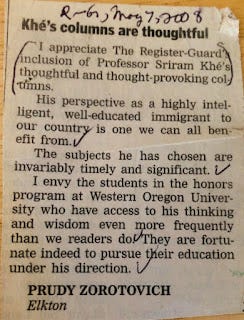
A now-deceased much older friend cut that letter from the newspaper and brought it over to me, and said that the letter-writer said everything that he had always wanted to tell me. That letter too went into my wallet. While the letter lives on as a photo, the thread disintegrated a few years ago.
Objects like those remind us about a lot of things about us, about this world. Like the old wall clock that I inherited from my grandmother; it is not a mere clock but is my connection to the old country, the people, and the waters that gave life to us.
Up until the last year of appa’s life, he and I often talked about the rains and water levels in the rivers and reservoirs. Neither he nor I were farmers. We, the father and son, had become the villagers who talked about rains all the time. We were not what one might call environmentalists. But, we both talked about the waters because we clearly understood its importance to life. And, the waters we talked about were the waters that answered the question that was never asked of us: “who are your waters?”
The water that makes life possible in Pattamadai and Sengottai and anywhere on this “pale blue dot”. My life here by the Willamette is nothing but the continuation of the life my people had by the Thamirabarani.
May we never forget who our waters are!
PS: After completing the errands, while walking by the river, I saw a bald eagle flying low over the water. It circled around a few times. What a blessing!
I still consider myself fortunate to have taken every class you offered during my time of study. Reading your posts I am still impressed by how deeply you consider the topics you discuss. Sometimes I look for the assignment to follow the lecture! 🤭 Interesting the poster of that news paper clip is from Elkton, as one of my heart's homes is there on the Umpqua River. I like that your sentiment to the string was the intention behind the giving, it's exactly how I approach such things. My father picked up obsidian knapping in his retirement, and many of us now keep an arrowhead or a heart with his energy attached to it. A friend said "Obsidian is known as the rock of wisdom and truth, characteristics your dad shared". Those eagle sightings are also said to hold meaning, strength, freedom, divine protection. A blessing indeed!
I remember biking along the American River trails with my dad during our early years in CA and luxurious summers swimming in the St. Maries River that ran along my grandparents' property in ID as a teenager. Since taking up residence in Western Washington I wake up some mornings and am surprised to walk out into my garden and "smell my childhood summers" (a damp piney scent) which were spent, for over a decade, in Western Washington. I am awed by the way my senses became the pathways to memories I didn't realize I carried.