
War's butterfly effects
“When elephants fight, it is the grass that suffers” is often quoted as a Swahili proverb. It does not even take a fight for the grass to suffer. Sometimes, all it takes is one rogue elephant with testosterone pumping through its young body to go on a rampage causing enormous destruction to human lives and property.
That proverb and the metaphor of a rogue elephant are my go-to every single time that the US goes to war because less developed countries—and there are dozens of them around the world—always suffer terrible consequences even when they are far removed from the conflict zone.
The Hindu, which is the newspaper that I grew up with, and the paper that my father tried to read even in his final months as his eyes were failing him, continues to be my primary source for news about the old country. As expected, the newspaper has plenty of reports on how the US-Israel bombing of Iran has affected India and Indians. During the first couple of days, it was mostly about flights that messed up travel plans for expats in the Middle East and for Indians at home. Now, it is mostly about how the grass has begun to suffer, and it is primarily because of a looming energy shortage.
India imports about half of the enormous quantity of natural gas that the rapidly growing large economy needs for businesses and homes. And with “more than 85% of all of India’s imports having to cross Strait of Hormuz” one does not need any advanced degree to figure out that it will be only a matter of days before even a homemaker in a small town in India faces a shortage of cooking gas.
I remember the bad old days prior to gas becoming a common feature of Indian kitchens. In Neyveli, amma worked with kerosene and coal stoves. In Sengottai and Pattamadai, my grandmothers and aunts used firewood and coal, and kerosene was used only to make coffee in the afternoons. The gas cylinder in the kitchen transformed lives. But, Amma, like all the women across the country who used gas, had to keep track of the number of days a cylinder had been in use and then place an order for a replacement, because of the waiting list for cylinders.
The next step in this transformation was when households could have two cylinders at home. Amma became adept at switching cylinders, the connections and all, and chased appa away if he even attempted to help. She knew what she was doing and needed no interference.
The usage of gas cylinders for cooking became widespread. It became common for street food stalls to also use gas cylinders to cook those awesomely flavorful snacks that I could no longer eat when visiting India because my gut could not tolerate spicy hot foods.
Now, there is a fear, worry, over shortage of gas.
People are rushing to buy electric cooktops in a country that cannot guarantee 24x7 electricity:
Amid the LPG shortage across the country owing to the war in West Asia, e-commerce platforms and retailers in major cities have seen a surge in demand for induction cooktops as people look for replacements due to the gas supply disruption.
While prices for electric cooktops have gone up, supplies largely remained available on e-commerce platforms and retail stores though the inventory is going down at a fast clip.
Even at cremation centers because not all of them have gone electric:
Amid a nationwide crisis, contractors running crematoria under the Greater Chennai Corporation (GCC) said they are facing difficulties booking LPG cylinders amid a supply disruption that has tightened availability at distributor godowns. …
According to him, an average of five cremations take place at the facility everyday and each cremation requires about 10 kg of LPG. Based on the current stock, supplies at the crematorium may last up to a week, he said.
According to the contractor for this facility, distributors are not immediately accepting bookings for additional cylinders for the coming days. He manages seven other crematoria in the city.
The dead too are affected by the war!
The rogue elephants have messed it all up in India.
It is not only India that is affected. One can find similar reports about energy shortages across the world.
There’s more than energy at stake, however, because of the gazillion ways in which oil and natural gas are used.
Consider, for instance, the following headline of a Grist report:
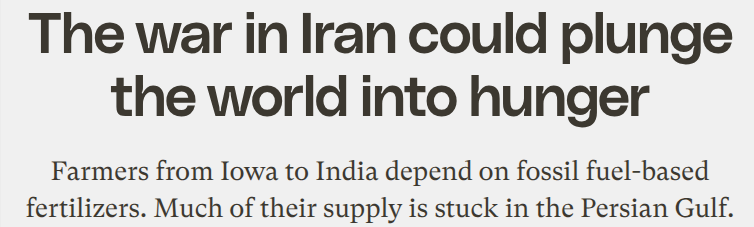
What is the connection?
Another world crisis sparked by the war in Iran may also be in the offing. That’s because the region’s oil and gas production has made it one of the world’s leading exporters of nitrogen fertilizers, which are indispensable to the global food system. To produce the chemicals used to grow much of the planet’s crops, natural gas is broken down to extract hydrogen, which is combined with nitrogen to make ammonia, and then mixed with carbon dioxide to make urea. All told, nearly a third of the global trade for nitrogen fertilizer passes through the Strait of Hormuz, while almost half of the world’s sulfur, essential in producing phosphate fertilizers, also travels through the corridor.
One might be tempted to argue that maybe this presents an opportunity to grow food without all those damn chemicals. Well, think again.
About 4 billion people on the planet eat food grown with synthetic nitrogen fertilizers. Roughly half of the global population, in other words, is alive because of these chemicals converted into nutrients for plants, said Lorenzo Rosa, who researches sustainable energy, water, and food systems at the Carnegie Institution for Science at Stanford University.
Oh, do you also recall the disastrous experiment in Sri Lanka more than five years ago after the government banned fertilizers and promoted organic farming? I do because I blogged about it in a post in which I quoted a NYT report:
[Farmers] and agriculture experts blame the policy for a sharp drop in crop yields and spiraling prices that are worsening the country’s growing economic woes and leading to fears of food shortages.
Prices for some foodstuffs, like rice, have risen by nearly one-third compared with a year ago, according to Sri Lanka’s central bank. The prices of vegetables like tomatoes and carrots have risen to five times their year-ago levels.
Farmers here in the US are also dependent on fertilizer that is imported.
USDA Secretary Rollins acknowledged this vulnerability in Tuesday’s press conference. “We are getting almost all of our urea, almost all of our phosphate, almost all of our nitrogen from other countries around the world, and that has to stop,” she said.
As even backyard gardeners know well, the time to plant is round the corner, which is not when farmers want to face shortage in fertilizer or a massive price hike either.
So, anything good from this war?
“The United States is the largest Oil Producer in the World, by far, so when oil prices go up, we make a lot of money,” the president wrote on Truth Social.